
AI Search Readiness for WordPress: A Practical Stack for 2026
Prepare your WordPress site for AI crawlers and answer engines without chasing hype. A clear stack covering crawl access, content, structured knowledge, measurement, and maintenance.
Quick answer: AI search readiness is not a new ranking algorithm. It is a practical stack: let the right bots in (or keep them out on purpose), publish clear pages, add curated discovery files, explain who you are with structured knowledge, and measure what actually visits your WordPress site.
Search still matters. Google Search Console still tells you which queries earn impressions and clicks. What has changed is that assistants, AI search products, and training crawlers now request your pages too. Those visits do not show up as classic organic sessions, and they do not behave like a single “AI Google.”
This guide is the hub for our AI discovery cluster. Use it to understand the full stack, then dive into the linked deep dives when you are ready to act.
What AI search readiness is (and is not)
It is:
- Making sure AI crawlers can reach the pages you want them to see
- Writing pages that answer questions cleanly enough to extract
- Publishing optional discovery files such as
/llms.txt - Adding site-wide entity context when that fits your goals
- Measuring bot hits and (where available) AI referrals
- Maintaining those signals as your content changes
It is not:
- A promise that ChatGPT, Perplexity, Gemini, or any other product will cite you
- A replacement for titles, internal links, or Search Console work
- A single score that predicts “AI visibility”
- Proof that a crawler visit equals a user asking about your brand
Treat readiness like security hygiene or accessibility: useful whether or not one vendor publicly commits to a file format this quarter.
The readiness stack
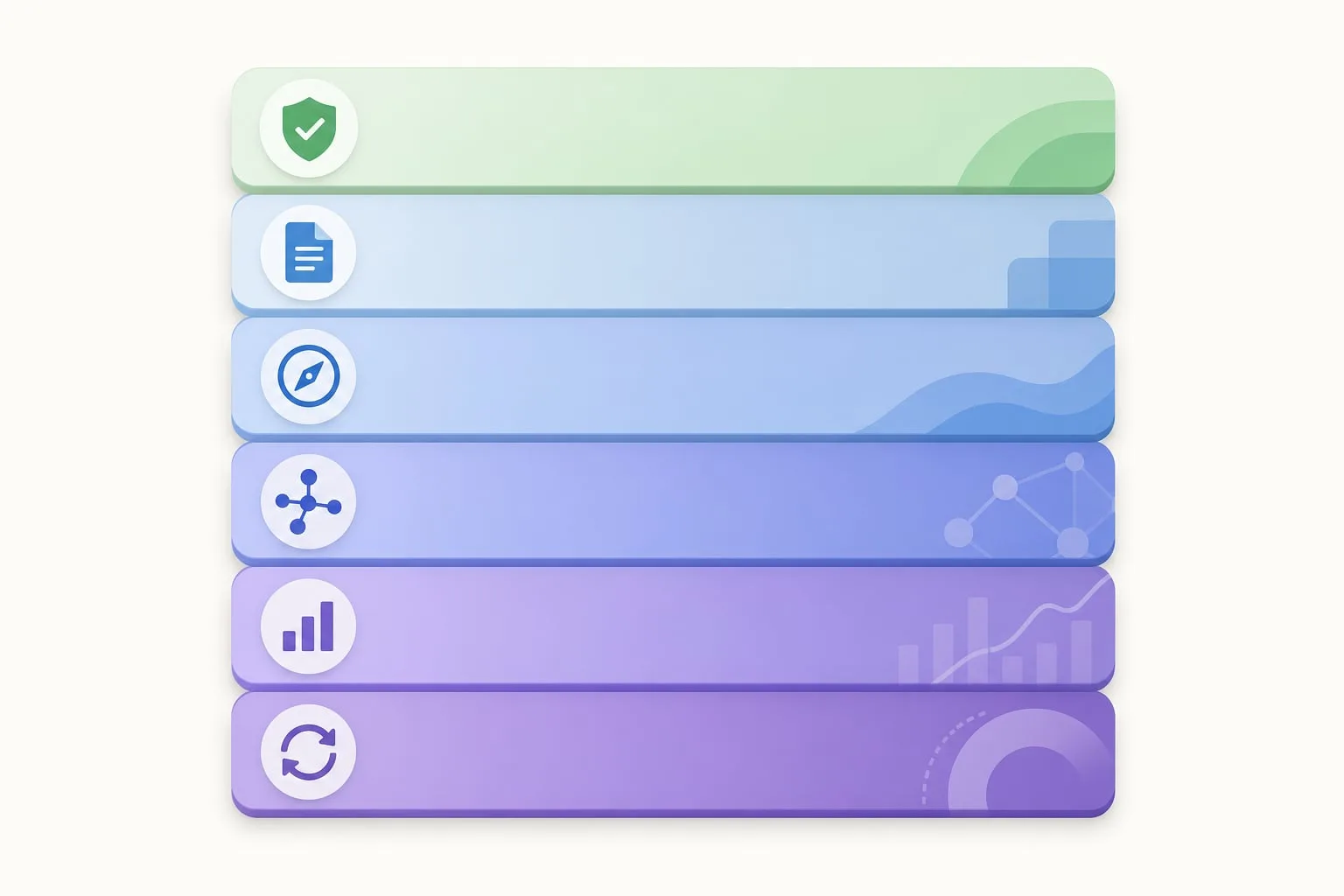
Think in layers. Skip a layer and the layers above it get weaker.
| Layer | Goal | Typical WordPress work |
|---|---|---|
| 1. Crawl access | Decide who may fetch your site | robots.txt, bot policy, hosting firewalls, optional blocking |
| 2. Content clarity | Make pages easy to extract and quote | Clear H1/H2s, concise answers, updated facts, full rendered HTML |
| 3. Curated discovery | Point systems at your best pages | llms.txt |
| 4. Structured knowledge | Explain entities, relations, and evidence | schema.org + Entity Map |
| 5. Measurement | Separate search demand from bot activity | GSC + AI bot tracking |
| 6. Maintenance | Keep signals honest over time | Re-check after theme/plugin changes, refresh maps and meta |
For a checklist-oriented view of the same ideas, see AI Readiness checklist for WordPress.
Layer 1: Crawl access and policy
Before any discovery file matters, a bot must be allowed to fetch the URL.
- Confirm important pages are indexable and not blocked by
robots.txtor password walls. - Review hosting and security plugins that challenge unknown user agents. Aggressive bot fights can block legitimate AI crawlers along with scrapers.
- Decide whether you want training crawlers, answer-engine crawlers, both, or neither. Those are different policies, not one switch labeled “AI.”
- If you block a bot, document why. Accidental blocks look identical to “the AI ignores us.”
SEO Booster’s AI Bot Tracking helps you see which known AI user agents hit content URLs. Pro can selectively block by purpose when that matches your policy. Neither feature changes how Google Search ranks pages.
Layer 2: Content clarity on the rendered page
Assistants that fetch a page receive HTML, not your Gutenberg sidebar. That is why full-page SEO analysis matters for AI readiness as much as for classic SEO.
Prioritize:
- One clear topic per URL
- Question-shaped headings where they match real queries (question-based queries)
- A short direct answer near the top, then supporting detail
- Fresh facts (prices, versions, dates, product names)
- Working internal links so related evidence is easy to find
- Schema that matches visible content, not invents claims
If the live page has a duplicate H1 from the theme or missing meta from a plugin conflict, editor-only checks will not save you. Fix the HTML users and bots actually receive.
Layer 3: Curated discovery with llms.txt
llms.txt is a proposed Markdown file at /llms.txt that gives a short site summary and curated links. It is intentionally smaller than a sitemap. Sitemaps list everything you want indexed. llms.txt should list the pages you would hand a smart intern on day one.
Important qualifications:
- It is a convention, not a universal ranking signal.
- Major search engines have not adopted it as a Search ranking factor.
- Publishing one is low cost and clarifies your priorities even when adoption is uneven.
On WordPress, SEO Booster can generate and serve /llms.txt from Tools. Deep dive: llms.txt for WordPress. Setup steps: llms.txt docs.
Layer 4: Structured knowledge (schema + Entity Map)
Page-level schema.org markup describes a single URL: Product, FAQPage, Organization, Article, and similar types. It can improve how search engines understand that page. It does not guarantee rich results, and Google has restricted several rich-result types over time.
Site-level Entity Map (EntityMap v1.0) is different. It publishes /entitymap.json and /entitymap.html as an entity-first index: who the publisher is, which concepts matter, how they relate, and which evidence chunks support each claim. Where a sitemap lists URLs, an Entity Map describes knowledge.
Compare the files in detail: Entity Map vs llms.txt, schema.org, and sitemap.xml.
Product path if you want this inside WordPress: Entity Map (Pro) and the Entity Map guide.
Layer 5: Measurement without self-deception
Use two dashboards with different jobs:
| Signal | What it measures | What it does not prove |
|---|---|---|
| Google Search Console | Impressions, clicks, queries, positions in Google Search | Assistant citations or training use |
| AI bot hits | Requests from known AI user agents | That a human asked about you, or that you were cited |
| AI referrals (when referrers are present) | Humans arriving from some AI products | Complete attribution (many clients strip referrers) |
A useful pattern: high AI bot activity on a URL with weak GSC impressions. That may mean the page is discoverable to crawlers while search presentation still needs work. It is a hypothesis, not proof of “AI demand.” See Bridge the Gap for a careful workflow.
Layer 6: Maintenance
AI readiness decays the same way SEO does.
- Revisit
/llms.txtwhen you publish or retire pillar pages. - Re-validate Entity Map after major site restructuring.
- Re-run full-page analysis after theme or SEO plugin changes.
- Review bot logs after WAF or security plugin updates.
- Keep Organization and sameAs links consistent across schema, Entity Map, and about pages.
A 30-day plan for a typical WordPress site
Week 1: Access and baseline
- Confirm
robots.txtand security settings match your AI bot policy. - Enable AI bot tracking (and referrals if available).
- Connect Search Console if it is not already connected.
- Note your top pages by clicks and by AI hits separately.
Week 2: Content and HTML truth
- Pick 10 to 20 URLs that matter commercially or editorially.
- Run full-page analysis on each.
- Fix title/meta, heading, schema mismatches, and broken links first.
- Add concise answers for the questions those pages already rank for.
Week 3: Discovery files
- Publish a curated
llms.txtwith 10 to 30 links, not your entire archive. - Optionally enable discovery signals (
LLMS:in robots.txt, link headers) when your tooling supports them. - If you need organization-level context, draft an Entity Map and validate it before going live.
Week 4: Close the loop
- Compare AI hits vs GSC impressions on the curated URLs.
- Strengthen internal links from strong pages to underlinked pillars.
- Schedule a quarterly review on your calendar.
How SEO Booster fits (without replacing judgment)
SEO Booster is built around this stack:
- Search Console sync and SEO Possibilities for proven search work
- AI Bot Tracking for crawler measurement
- Free llms.txt generator in Tools
- Pro Entity Map for
/entitymap.jsonand/entitymap.html - AI Readiness as an editor checklist derived from analysis (a heuristic, not an industry score)
- Full-page SEO review against rendered HTML
Use the product where it saves time. Keep your strategy honest about what no plugin can promise.
Related reading in this cluster
- Agent readiness on seoboosterpro.com (marketing-site dogfood: Content Signals, Link headers, skills, no fake MCP)
- llms.txt for WordPress
- Entity Map vs llms.txt, schema.org, and sitemap.xml
- Structured data for AI search
- AI Readiness checklist for WordPress
- Bridge the Gap: AI visits vs GSC impressions
- Full-page SEO analysis for WordPress
- Optimizing for question-based queries
The takeaway
AI search readiness is preparedness with receipts. Control crawl access, publish clear pages, curate discovery files, add structured knowledge when it helps, and measure bots separately from Google Search. Do that consistently and you improve the odds that both search engines and AI systems can understand your WordPress site, without pretending any single file is a magic citation switch.
Frequently asked questions
What is AI search readiness for WordPress?
AI search readiness means your site can be crawled by AI systems when you allow it, presents clear answerable content, publishes useful structured signals, and gives you a way to measure bot activity. It is a preparedness practice, not a guaranteed ranking or citation strategy.
Is AI search readiness the same as SEO?
No. Classic SEO still focuses on Google Search visibility, clicks, and rankings. AI readiness overlaps with good technical SEO, but adds curated discovery files, entity-level context, bot measurement, and clearer answer formatting for assistants.
Does publishing llms.txt or Entity Map guarantee AI citations?
No. llms.txt is a proposed convention and EntityMap is an emerging open standard. Both help you publish clearer information. Neither guarantees that any specific AI product will crawl, cite, or prefer your pages.
Where should a WordPress site owner start?
Start with crawl access and content quality, then add a curated llms.txt, measure AI bot traffic, and consider an Entity Map when you want structured organization context. Use Search Console for search demand that you can prove.
On this page