
Entity Map vs llms.txt, schema.org, and sitemap.xml: What Each File Is For
Compare Entity Map, llms.txt, schema.org markup, and sitemap.xml without the marketing fog. Learn what each signal does, what it cannot guarantee, and when WordPress sites need which layer.

Quick answer: sitemap.xml lists URLs. llms.txt curates where an LLM should start. schema.org describes individual pages. Entity Map declares site-wide entities, relations, and evidence. Use them as complementary layers, not as competing “AI SEO tricks.”
This comparison article is part of AI search readiness for WordPress. For the WordPress product path, see Entity Map (Pro) and the Entity Map docs.
Why people confuse these files
Every few years the web invents another root file or markup pattern. Marketers mash them into one pitch: “publish this and AI will understand you.” The truth is quieter. Each format answers a different question.
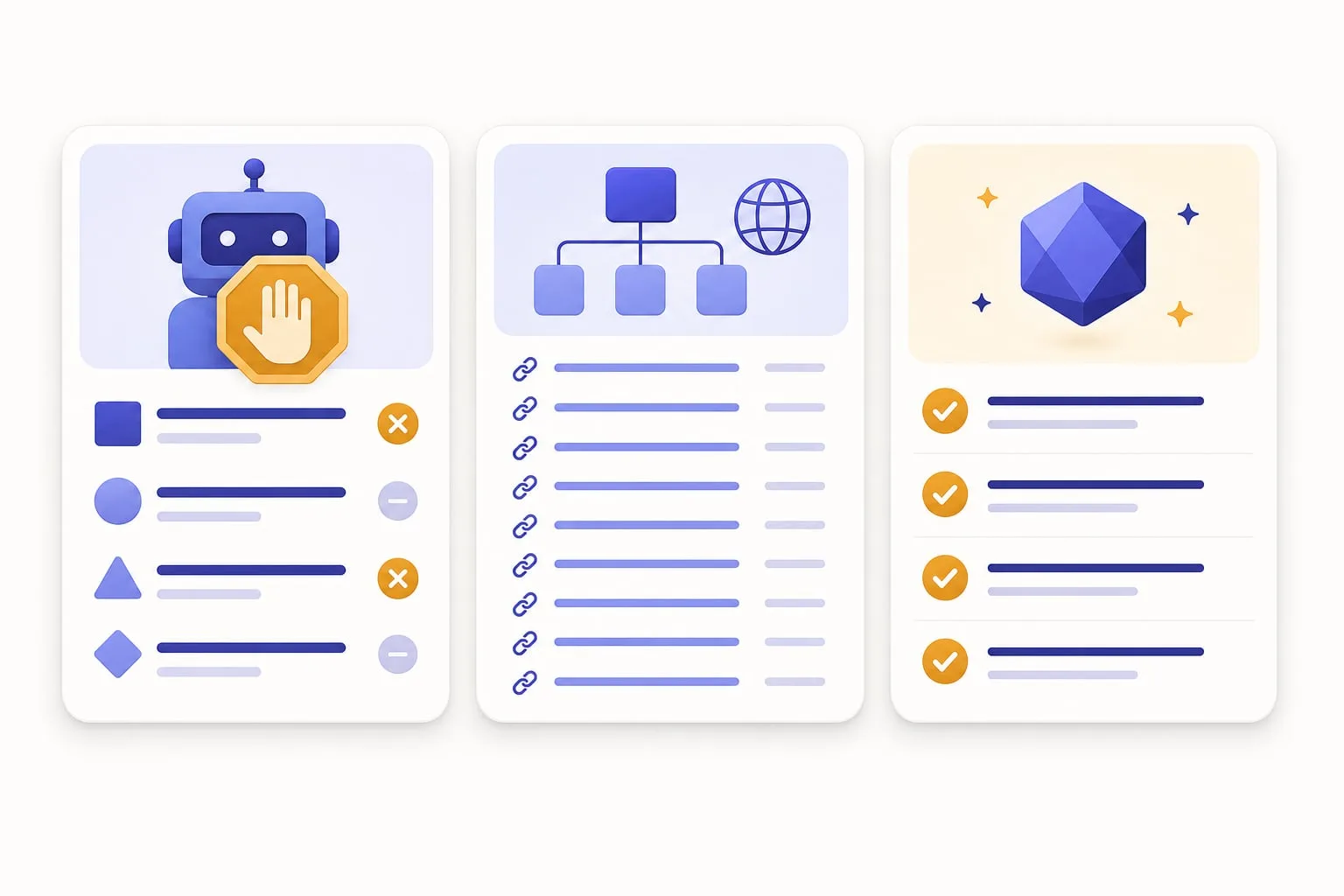
| Format | Primary question it answers | Typical location |
|---|---|---|
sitemap.xml | Which URLs exist and should be discovered? | /sitemap.xml or sitemap index |
llms.txt | Where should an LLM start reading? | /llms.txt |
| schema.org | What is this page about? | JSON-LD / microdata in page HTML |
| Entity Map | Who is the publisher, which entities matter, how do they relate, and what evidence supports them? | /entitymap.json + /entitymap.html |
If you only remember one sentence: llms.txt tells AI where to start. Entity Map tells AI who you are.
sitemap.xml: still the inventory
Sitemaps are mature. Search engines use them to discover and recrawl URLs. WordPress SEO plugins generate them automatically.
Good for: large sites, new URLs, pagination edges, making sure crawlers know a page exists.
Not enough for: explaining that “SEO Booster” is a product from CleverPlugins related to Entity Map and llms.txt. A sitemap row is a location, not a definition.
llms.txt: the curated front desk
Covered in depth in llms.txt for WordPress. Short version:
- Proposed Markdown convention (llmstxt.org)
- Small on purpose
- Complements robots and sitemaps
- Not a Google Search ranking factor
- Valuable as editorial clarity even when adoption is uneven
Think of it as the one-page briefing you wish every intern received.
schema.org: page-level meaning
schema.org types and properties annotate a page so machines can parse offers, authors, FAQs, products, and organizations more reliably. On WordPress, your SEO plugin usually emits JSON-LD.
Strengths:
- Widely documented
- Eligible (sometimes) for rich results in Google Search
- Helps disambiguate visible content
Limits:
- Markup must match visible content
- Rich results are never guaranteed; Google has reduced FAQ and HowTo eligibility for many sites
- Page-level graph fragments do not automatically produce a clean site-wide knowledge index
For the broader structured-data playbook, see Structured data for AI search.
Entity Map: site-wide entities and evidence
EntityMap is an open standard for a structured, entity-first index designed for AI agents, LLMs, and RAG-style pipelines. Conforming sites publish:
/entitymap.jsonfor machines/entitymap.htmlfor human and crawler-readable review
A valid map includes at least:
- A root object with publisher identity
- One or more entities
- At least one evidence chunk per entity
- Exact publisher attribution on chunks (the publisher string must match the root publisher name)
Relations use a controlled predicate vocabulary (for example PART_OF, ENABLES, DESCRIBED_BY). Chunks are short extractive passages with sourceUrl and pageTitle, not free-form marketing essays.
What Entity Map adds beyond schema:
- One predictable root index instead of hunting JSON-LD across thousands of templates
- Explicit relationships across the whole site
- Publisher attribution intended to survive chunking in retrieval pipelines
- A human HTML companion for QA
What it does not add:
- Guaranteed ingestion by OpenAI, Google, Anthropic, or anyone else
- A substitute for accurate page content
- Automatic rich results in Google Search
EntityMap files are publisher assertions. Self-declared maps are normal; third-party certification (when available) is a separate trust layer.
Side-by-side decision guide
| If your goal is… | Start with… | Then consider… |
|---|---|---|
| Help Google discover URLs | sitemap.xml | Search Console inspection |
| Give AI systems a short starting list | llms.txt | Linking Entity Map from that file |
| Describe a product page or article | schema.org on that URL | FAQ/Product only when content supports it |
| Publish who you are and how topics connect | Entity Map | Keep schema on key pages too |
| Measure whether bots show up | Server logs / AI Bot Tracking | Compare with GSC, do not conflate them |
A simple architecture that works on WordPress
- Keep your SEO plugin’s sitemap and Organization schema.
- Publish a curated
llms.txtwith pillar pages only. - Add Entity Map when you care about entity clarity and attribution, especially for product + docs + company graphs.
- Link Entity Map from llms.txt and optionally advertise it in
robots.txt(EntityMap:line) and HTMLrelhints. - Validate JSON before you share it with partners or call it live.
Live example on this site: /entitymap.json and /entitymap.html. Validate with entitymap.org/validate.
How SEO Booster implements the split
- Free: llms.txt generator, AI bot tracking, AI Readiness checks
- Pro: Entity Map Tools wizard to build from site data (and optional AI), edit entities/relations/chunks, then publish
/entitymap.jsonand/entitymap.html - Optional sync between llms.txt curation rules and Entity Map content selection
- Discovery toggles for Structured knowledge links and robots.txt hints
Commercial overview: Entity Map feature page. Broader stack: AI search readiness.
Mistakes that waste the format
- Treating Entity Map as a second sitemap (hundreds of thin entities, no real chunks)
- Copying marketing slogans into evidence chunks instead of extractive page text
- Mismatched publisher strings (breaks attribution rules)
- Publishing generator drafts without human review for proprietary terms
- Leaving a physical
entitymap.jsonin the web root that shadows the dynamic route - Claiming “now AI understands us” in client reports without measurement
The takeaway
You do not pick one winner among sitemap, llms.txt, schema.org, and Entity Map. You assign each format the job it was designed for. Inventory URLs with sitemaps, curate starting points with llms.txt, annotate pages with schema, and publish site-wide entities with Entity Map when that layer earns its keep. For the readiness checklist that ties these together, continue to AI Readiness checklist for WordPress.
Frequently asked questions
What is an Entity Map?
An Entity Map follows the EntityMap open standard. Sites publish /entitymap.json for machines and /entitymap.html for humans, describing organizations, concepts, relationships, and evidence chunks. It is a site-wide knowledge index, not a list of every URL.
How is Entity Map different from schema.org?
schema.org markup usually describes one page (a Product, Article, or FAQ). Entity Map declares site-wide entities, typed relations, and attributed evidence in one root index. They complement each other rather than replace each other.
Do I still need llms.txt if I have an Entity Map?
Often yes. llms.txt is a curated starting index of pages. Entity Map explains who you are and how concepts connect. Many sites publish both and link Entity Map from llms.txt under Structured knowledge.
Is Entity Map required for AI search?
No. It is an emerging open standard. Publishing a valid map improves clarity and attribution potential. It does not guarantee that any AI product will ingest or cite your content.
On this page