
Google Search Console Overview
SEO Booster’s Google Search Console Overview brings keyword performance into your WordPress dashboard. Search and filter imported GSC data, spot content gaps and declining terms, then jump straight to the page that needs work, without switching tools.
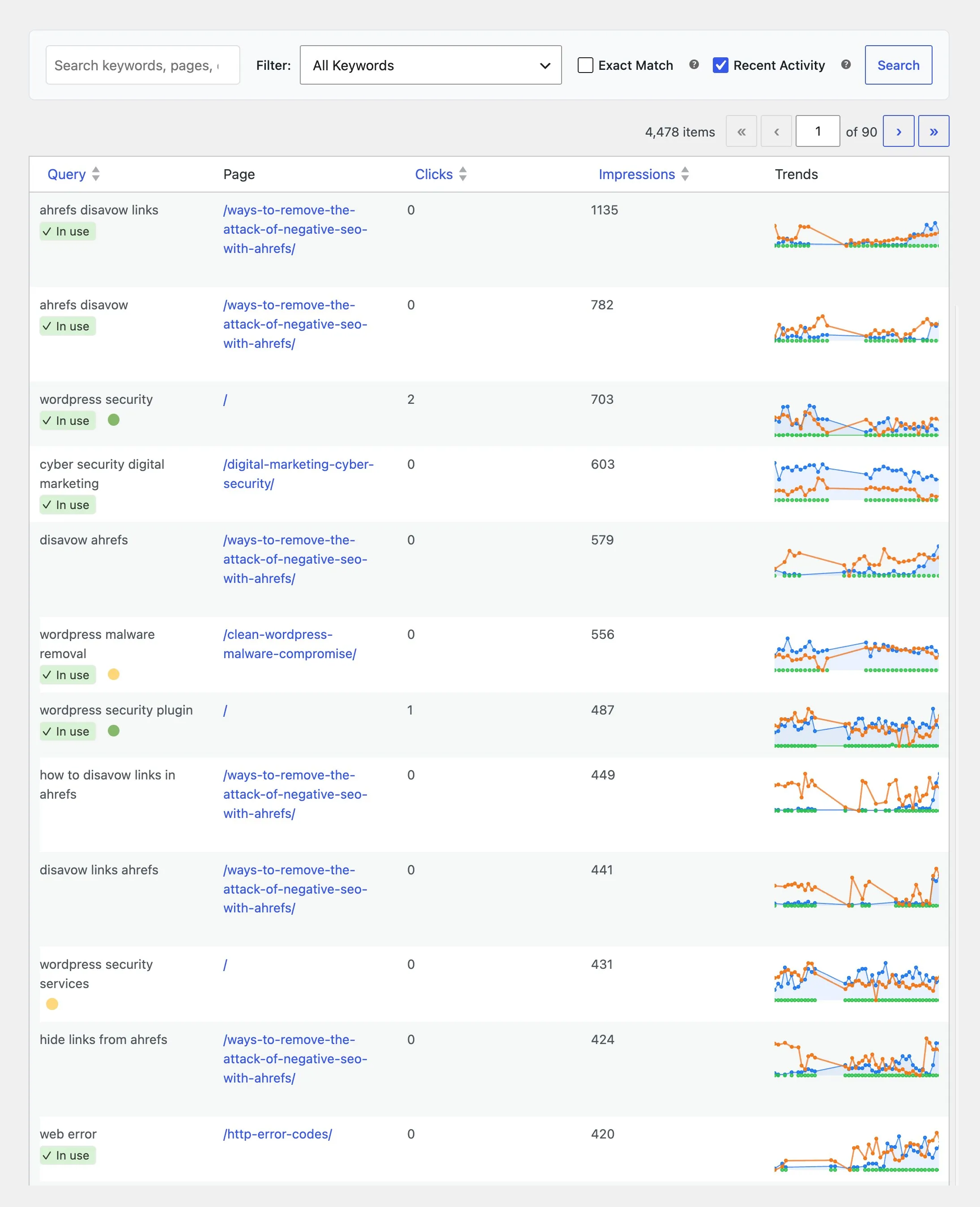
Part of the seo booster WordPress plugin.
Works with your SEO plugin, and makes it smarter.
Keep the SEO plugin you already use. We add Search Console context, a clear fix list, automatic links, and tools that write into the meta you already have. Works with Yoast, Rank Math, AIOSEO, SEOPress, and TSF.
- Yoast SEO
- Rank Math SEO
- All in One SEO (v4+)
- SEOPress
- The SEO Framework (v5+)
All your GSC keyword data in one place
What is it?
A searchable table of impressions, clicks, CTR, and position with filters, row signals, and trend charts per keyword.
Who is it for?
SEO managers who review keyword performance daily inside WordPress, not in a separate Search Console tab.
What does it solve?
Copying metrics out of Search Console. Find content gaps, declining terms, and cannibalization, then edit from the same table.
How GSC Overview saves you time
Filter combinations that match real workflows
Stack filters, for example, keywords not used in content plus medium position (11–50): to find striking-distance gaps worth updating first.
Spot decay before rankings slip
"Not seen" rows, gray inactive styling, and "X days ago" labels show when a keyword last drove traffic so you can refresh content early.
Edit where you work
Use Edit row actions, the GSC metabox on posts, or the admin-bar keyword popup on the frontend to update pages without hunting URLs in Search Console.
Features of GSC Overview
Filter dropdown: what each option does
Open SEO Booster → GSC Overview and use the Filter dropdown with Search. All options combine with the checkboxes and search box below.
- All Keywords: no dropdown filter; shows the full imported list. Table clicks and impressions stay all-time totals
- New Keywords (Past 30 Days): keywords with a last-visit date within the past 30 days
- Keywords Not Seen (Over 30 Days): keywords whose last recorded visit was more than 30 days ago
- Keywords Found in Content: queries SEO Booster detected in the page body
- Keywords Not Used in Content: content-gap analysis; terms getting search visibility but missing from the page
- High Average Position (1–10): average position between 1 and 10 for the selected date range
- Medium Average Position (11–50): striking-distance terms often worth a targeted update
- Low Average Position (50+): long-tail or early-stage terms; pair with high impressions to find hidden demand
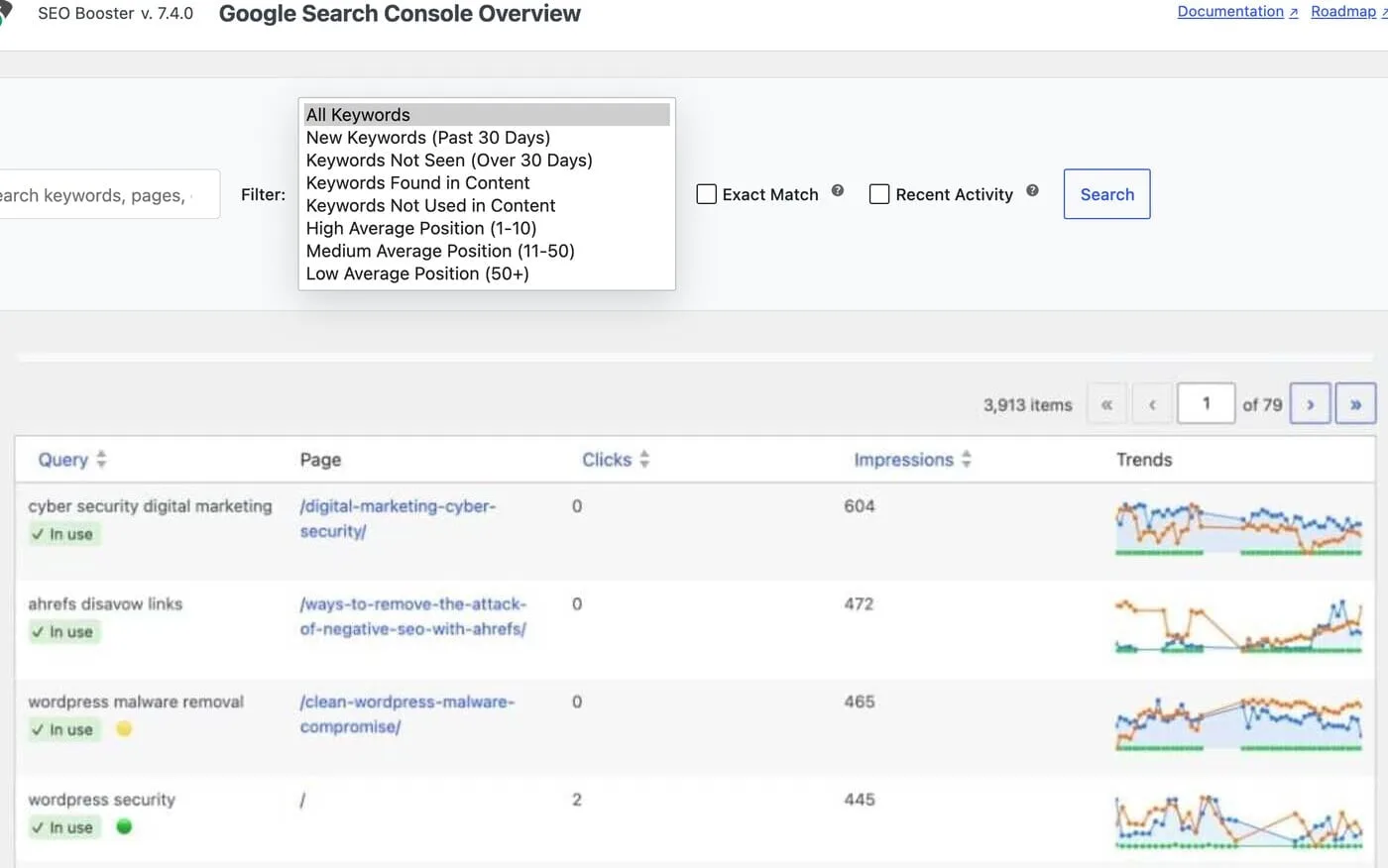
Exact Match checkbox
One checkbox beside the filter dropdown changes how the search box matches. Use the Filter dropdown when you want new keywords or keywords not seen recently.
- Exact Match: off by default. When checked, search matches the keyword exactly. When unchecked, search matches partially against keywords, page URLs, and dates
- Search box: enter a keyword, URL path, or date fragment, then click Search. Works together with the dropdown and Exact Match
- Clicks, impressions, CTR, and position in the table are all-time totals from imported Search Console data
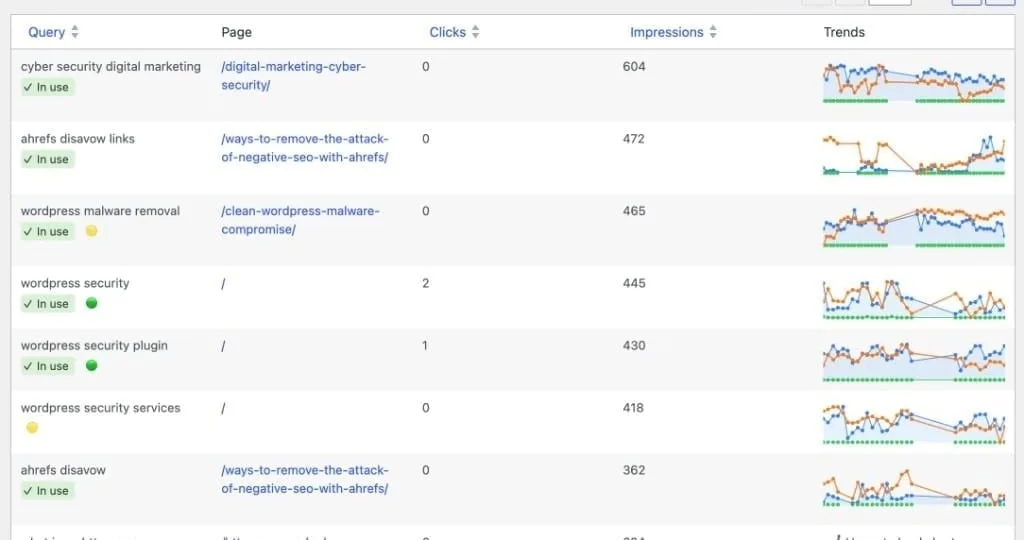
Table columns, sorting, and row signals
Each row is one keyword–page pair from imported GSC data. Click column headers to sort; default sort is by impressions (highest first).
- Query: keyword text plus badges. In use means the term appears in page content. A days-ago label appears when the last visit was 14+ days back
- Green / yellow dots: traffic leader vs keyword cannibalization when multiple pages compete for the same query (hover for click comparison)
- Page: linked URL with Edit (when WordPress knows the post) and View actions
- Clicks and Impressions: all-time totals from imported GSC data. Trend charts use a recent window (up to 90 days; full history cap 180 days)
- Trends: hover a row’s chart placeholder to load a sparkline of performance over time
- Gray rows: keywords with no traffic in 30+ days stand out visually even before you apply the Not Seen filter
Keywords in the editor
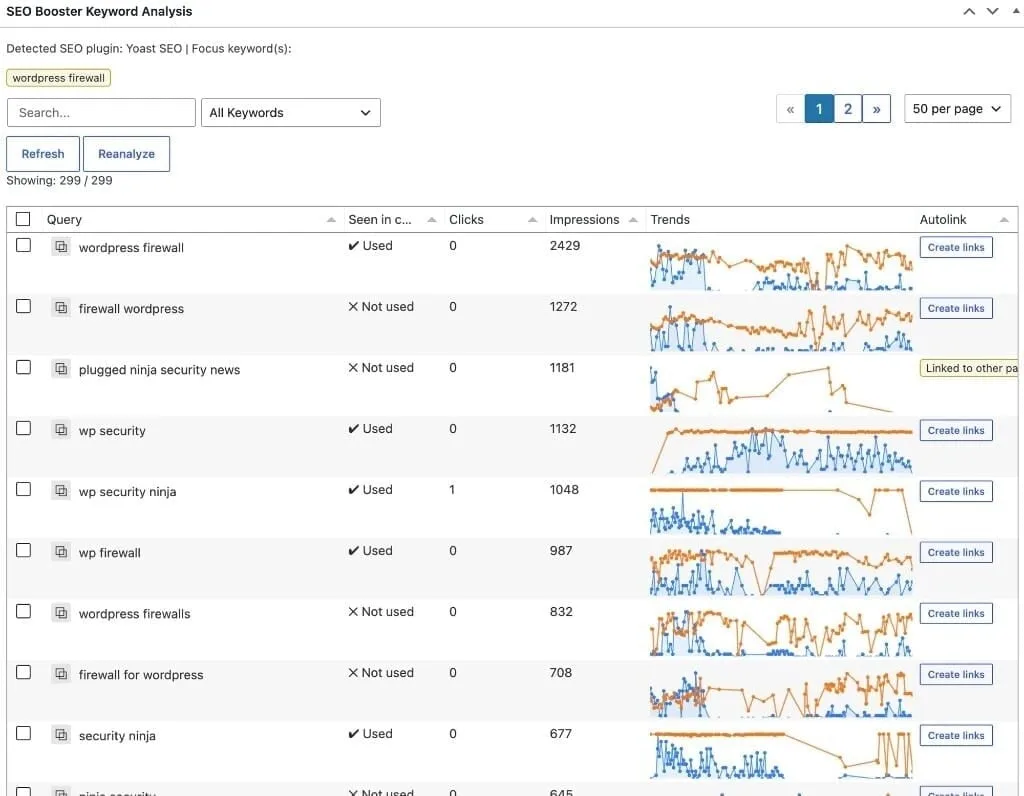
The same imported GSC data powers the Keywords tab in the SEO Booster metabox on posts, pages, taxonomies, and WooCommerce products, filters, trends, and Pro Create links without leaving the edit screen.
- Per-URL keyword list with Used / Not used status and reanalyze
- Content-gap and CTR-style filters to find easy wins
- Pro: autolink status and one-click Create links from the Keywords tab
- See the full metabox story on the Edit Screen feature page
Page overview on the frontend
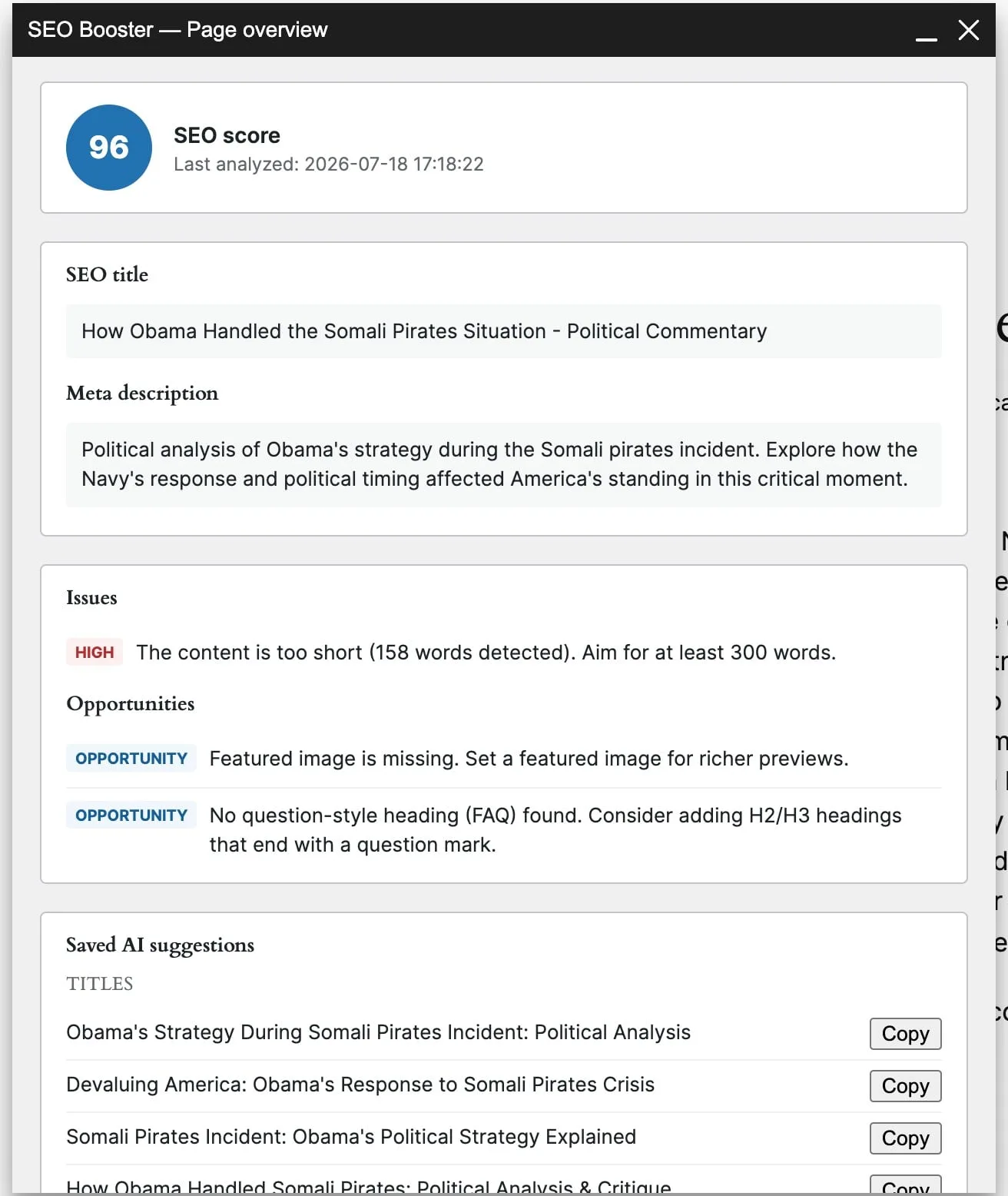
While browsing your live site (logged in), open WordPress admin bar → SEO Booster → Page overview for a floating snapshot of the current URL, score, title and meta, issues, and top keywords. Separate from the sitewide GSC Overview table.
- Floating Page overview panel over the page you are viewing
- Highlight GSC Keywords to see imported terms in rendered content
- Top keywords when GSC data exists for that URL
- Full walkthrough on the Page overview feature page
How to use GSC Overview
Connect and wait for import
Connect Google Search Console from the SEO Booster dashboard via OAuth. The first import pulls up to 90 days of history; daily sync keeps data fresh (Google’s reporting delay applies).
Start with the default view
Open GSC Overview on All Keywords and sort by Impressions. Scan the top rows: these are your highest-visibility keyword–page pairs from the imported list.
Find content gaps
Set Filter to Keywords Not Used in Content, optionally add Medium Average Position (11–50), and click Search. Use Edit on promising rows to add missing terms to the page body.
Catch declining keywords
Choose Keywords Not Seen (Over 30 Days) and click Search. Gray rows and "X days ago" labels also flag stale terms in any view.
Investigate cannibalization
Look for yellow competition indicators on the Query column. When multiple pages fight for the same term, consolidate content or differentiate focus keywords.
Drill into one term or URL
Type a keyword or URL in the search box. Enable Exact Match when you need one specific query. Sort by Position or Clicks to prioritize next edits.
Trusted by WordPress site owners
“Before using SEO Booster Pro, our blog struggled to gain traction. Now, with smart linking and actionable keyword data, we’ve doubled our organic reach in just three months.”
Ava Mitchell
Content Strategist, Create & Grow Studios
Frequently Asked Questions
What is the SEO Booster GSC Overview feature?
GSC Overview is the searchable admin table at SEO Booster → GSC Overview. It lists imported Google Search Console keyword–page pairs with clicks, impressions, trends, filters, and quick Edit links: so you can act on search data inside WordPress. New to GSC in wp-admin? Start with the Google Search Console for WordPress beginners guide.
What filters are available in the GSC Overview?
The Filter dropdown includes: All Keywords; New Keywords (Past 30 Days); Keywords Not Seen (Over 30 Days); Keywords Found in Content; Keywords Not Used in Content; High Average Position (1–10); Medium Average Position (11–50); and Low Average Position (50+). Exact Match is an extra checkbox (exact query vs partial search).
Can I combine filters?
Yes. Pick a dropdown filter, set Exact Match if you need it, enter search text if you want, and click Search. All conditions apply together. Example: Keywords Not Used in Content plus Medium Position finds content-gap terms near page one. Example: Keywords Not Seen lists terms whose last visit was more than 30 days ago.
How do I see new or recently quiet keywords?
Use New Keywords (Past 30 Days) or Keywords Not Seen (Over 30 Days) in the Filter dropdown. All Keywords shows the full imported list. Table clicks and impressions stay all-time. Trend charts use a recent window (up to 90 days).
What do the row badges and colors mean?
In use means the keyword appears in page content. A days-ago label shows when the last visit was 14+ days back. Gray rows indicate 30+ days without traffic. A green dot marks the traffic leader when multiple pages rank for the same query; yellow indicates cannibalization: hover either dot for click details.
Can I search for specific keywords or URLs?
Yes. Use the search box for partial matches on keywords, page URLs, and dates. Enable Exact Match to require an exact keyword match. Click column headers to sort by query, clicks, impressions, CTR, position, or latest date.
How does the keyword filtering help improve SEO?
Content-gap filters show terms you rank for but do not use on-page, add them to strengthen relevance. Not Seen and declining labels highlight decay before rankings drop. Position bands help you prioritize striking-distance updates. Cannibalization indicators flag pages competing against each other.
Do I need to connect my Google Search Console account?
Yes. Connect via secure OAuth from the SEO Booster dashboard. On first import the plugin downloads up to 90 days of history, then refreshes on a daily schedule.
How often is the keyword data updated?
GSC data is refreshed on a daily schedule after the initial import. Google Search Console itself has a reporting delay of a few days: SEO Booster reflects imported GSC data, not live second-by-second rankings.
Is GSC Overview the only place I see keyword data?
No. The same imported data also appears in the Keywords tab on the edit screen, the dashboard chart, Tools (when the tool uses GSC data), Page overview Top keywords on the frontend, and GSC keyword highlighting from the admin bar when you want it.
Boost your rankings with smarter SEO
Connect Google Search Console, fix pages from real search data, automate internal links, and use AI when the repetitive work piles up.
Get Started